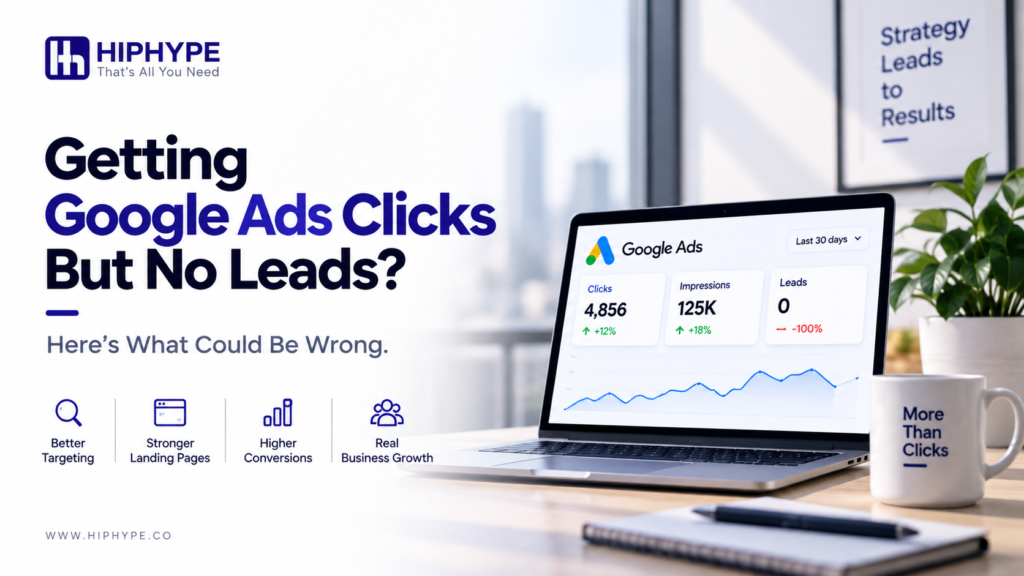
Getting traffic from Google Ads is not the same as generating business.
You may see impressions increase, clicks coming in, and even a healthy click-through rate—but if those visitors are not submitting forms, making calls, booking consultations, or taking other valuable actions, something in the conversion journey is breaking down.
The issue may not be your ad spend.
It could be search intent, keyword targeting, landing-page experience, conversion tracking, or the quality of the traffic you’re attracting.
Here is how to identify where the problem may be.
1. You’re Attracting Clicks, Not the Right Searches
A click only tells you that someone was interested enough to visit your website. It does not tell you that they were ready to become a customer.
For example, someone searching:
“How does Google Ads work?”
has a very different intent from someone searching:
“Google Ads agency for small business.”
The first search is primarily informational. The second indicates stronger commercial intent.
This is why keyword intent should be evaluated alongside click volume.
Review your Google Ads Search Terms Report to identify:
- Irrelevant searches
- Informational queries
- Low-intent keywords
- Unqualified traffic
- New negative keyword opportunities
The objective is not to maximize clicks.
It is to attract searches with genuine business intent.
2. Your Ad and Landing Page Tell Different Stories
A user clicks your ad because the message appears relevant to their search.
If the ad promises:
“Get a Free Google Ads Audit”
but the visitor lands on a generic homepage with no mention of the audit, the conversion journey immediately loses momentum.
Your ad-to-landing-page experience should feel consistent.
The landing page should reinforce:
- The promise made in the ad
- The user’s original search intent
- The specific offer
- The primary benefit
- The next action
This alignment reduces friction and helps visitors understand what to do next.
3. Your Landing Page Is Not Built Around Conversion
Even highly relevant Google Ads traffic can fail to convert when the landing page creates unnecessary friction.
Look for issues such as:
- A weak or unclear headline
- Too many competing CTAs
- Long or complicated forms
- Poor mobile experience
- Slow page performance
- Lack of trust signals
- Unclear value proposition
- Too much information before the main offer
A strong landing page should quickly answer three questions:
What are you offering?
Why does it matter to me?
What should I do next?
The easier you make those answers to understand, the fewer unnecessary barriers you create between the click and the conversion.
4. Your Campaign May Be Optimized for the Wrong Metric
A campaign can generate an impressive number of clicks and still produce disappointing business results.
For lead-generation campaigns, CTR should not be the final measure of success.
Think about the complete funnel:
Impressions → Clicks → Leads → Qualified Leads → Customers
Each stage tells you something different.
For example:
- High impressions + low clicks → ad or targeting issue
- High clicks + few leads → conversion-path issue
- Many leads + few qualified leads → targeting or offer issue
- Many qualified leads + few customers → sales or offer issue
This funnel-based approach gives you a much clearer picture of where optimization is actually needed.
5. Your Conversion Tracking May Be Incomplete
Before changing keywords, ads, or budgets, verify that your conversion data is accurate.
If Google Ads is not properly recording important actions, your optimization decisions may be based on incomplete information.
Review whether you’re correctly tracking:
- Form submissions
- Phone calls
- Consultation bookings
- Purchases
- Sign-ups
- Important button interactions
Also check the relationship between Google Ads, GA4, and your website’s conversion events.
A campaign that appears to generate “no leads” may sometimes have a tracking problem rather than a traffic problem.
Accurate conversion data is the foundation of effective Google Ads optimization.
6. You’re Measuring Leads Instead of Lead Quality
Generating 100 leads sounds better than generating 20.
But what if those 20 leads are genuinely interested prospects while the 100 are mostly irrelevant enquiries?
This is why Google Ads lead generation should not stop at counting conversions.
Where possible, connect advertising data with downstream business outcomes:
Lead → Qualified Lead → Sales Opportunity → Customer
This helps you identify which campaigns and keywords are contributing to actual revenue rather than simply producing inexpensive conversions.
A lower volume of highly relevant leads can provide more business value than a large volume of poorly qualified enquiries.
How to Improve Google Ads Conversion Performance
If your Google Ads are not generating leads, use a structured optimization process.
Audit Search Terms
Identify irrelevant and low-intent searches and strengthen your negative keyword strategy.
Review Keyword Intent
Prioritize keywords that align with your customers’ commercial and transactional intent.
Improve Ad Relevance
Make sure your ad directly addresses the searcher’s need and accurately represents the offer on your landing page.
Strengthen the Landing Page
Improve the headline, value proposition, CTA, trust signals, mobile experience, and conversion flow.
Verify Conversion Tracking
Make sure important conversions are being recorded accurately across your advertising and analytics setup.
Measure Lead Quality
Go beyond conversion volume and determine which campaigns, keywords, and ads are producing qualified business opportunities.
Don’t Optimize Google Ads for Clicks Alone
Clicks are an important part of paid search—but they are not the final business outcome.
A strong Google Ads optimization strategy connects the entire customer journey:
Relevant Search → Relevant Ad → Relevant Landing Page → Conversion → Qualified Lead → Customer
If one part of that journey is misaligned, increasing your advertising budget may simply increase the amount of inefficient traffic.
The better approach is to identify the actual bottleneck, fix it, and then scale what is working.
Conclusion
If your Google Ads are generating clicks but not leads, look beyond the ad itself.
Review search intent, keyword targeting, ad-to-landing-page relevance, conversion tracking, and lead quality before increasing your budget.
The goal of Google Ads is not simply to generate traffic.
It is to turn relevant searches into qualified business opportunities.
Frequently Asked Questions
Why are my Google Ads getting clicks but no leads?
Common causes include low-intent traffic, irrelevant search terms, weak landing pages, unclear CTAs, and inaccurate conversion tracking.
How can I get more leads from Google Ads?
Focus on high-intent keywords, relevant ad messaging, optimized landing pages, accurate conversion tracking, and qualified traffic rather than maximizing clicks alone.
Why are my Google Ads clicks not converting?
The issue may be the search intent, ad-to-landing-page mismatch, landing-page experience, offer, or conversion process.
How important is the landing page for Google Ads?
The landing page plays a critical role because it continues the user’s journey after the ad click. It should clearly communicate the offer and provide an easy path to conversion.
How does conversion tracking affect Google Ads?
Accurate conversion tracking shows which campaigns, keywords, and ads are producing valuable actions. Without reliable data, campaign optimization becomes much harder.
How can I improve my Google Ads conversion rate?
Start by improving search intent and targeting, ad relevance, landing-page experience, conversion tracking, and lead quality. Optimize the complete conversion journey rather than focusing on one metric.