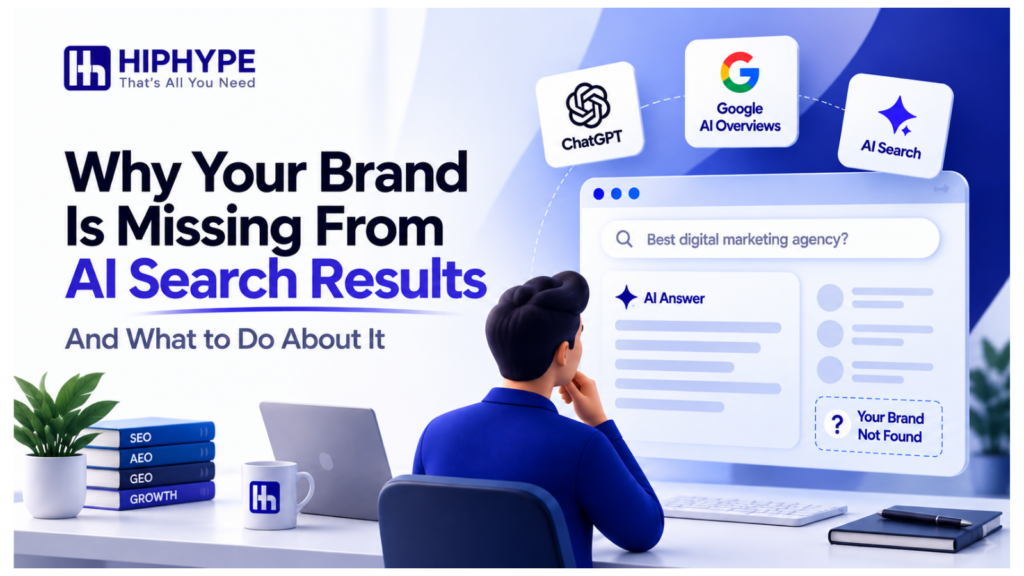
Your brand may rank on Google, have a professional website, and publish content regularly—yet still be missing when customers ask AI-powered search tools for recommendations, comparisons, or answers.
That is the new challenge in search visibility.
As search becomes more conversational, brands need to think beyond traditional rankings. AI search optimization focuses on making your brand, content, and expertise easier for search engines and AI systems to understand.
But if your brand is not appearing in AI search results, where should you start?
Why Is Your Brand Missing From AI Search Results?
1. Your Website Does Not Clearly Explain Your Brand
AI systems need clear context to understand a business.
Your website should clearly communicate:
- What your business offers
- Who you serve
- What problems you solve
- Your areas of expertise
- Your key services
- The industries or locations you serve
Avoid relying on vague statements such as “innovative solutions for modern businesses.”
Your homepage, service pages, About page, blogs, FAQs, and case studies should collectively create a clear picture of your brand.
The clearer your digital presence, the easier it is to understand what your brand is relevant for.
2. Your Content Focuses on Keywords Instead of Questions
Simply targeting a keyword like “AI search optimization” is not enough.
Think about what your audience actually wants to know:
- How do I appear in AI search results?
- Why is my brand not showing in AI search?
- How can I improve my AI search visibility?
- Does SEO still matter for AI search?
- What is GEO?
- What is the difference between GEO and AEO?
These questions represent real search intent.
Build content that provides direct, useful answers instead of repeatedly inserting keywords.
This approach also creates opportunities to target long-tail keywords such as how to improve AI search visibility and how to optimize for AI search.
3. Your Content Is Too Generic
Publishing content is not the same as providing valuable content.
If your article gives the same basic information available across dozens of websites, it gives your audience little reason to trust or remember your brand.
Strengthen your content with:
- Original insights
- Practical examples
- Industry-specific advice
- First-hand experience
- Research and credible sources
- Case studies
- Useful frameworks
- Actionable recommendations
Your goal should be simple:
Don’t just explain the topic. Help the reader solve the problem.
This is particularly important for GEO (Generative Engine Optimization) because strong content needs to provide meaningful information that can stand out in a crowded search environment.
4. Your Internal Linking Is Weak
Your blog should not exist as an isolated page.
Use relevant internal links to connect your content around related topics such as:
- SEO
- GEO
- AEO
- Content Marketing
- Analytics
- Google Ads
For example, when discussing Generative Engine Optimization (GEO), link to your detailed GEO/AEO resource.
5. Technical SEO Can Affect Your Visibility
Before focusing heavily on AI search visibility, check your technical SEO foundation.
Make sure:
- Important pages can be crawled
- Valuable pages are indexed
- Internal links connect important content
- Essential information is available as text
- Structured data, when used, accurately represents the page
Technical SEO is still an important part of SEO for AI search.
There is no single technical trick that guarantees visibility in AI search. A strong website foundation comes first.
SEO, AEO and GEO: What’s the Difference?
These three approaches can work together.
SEO
Search Engine Optimization focuses on improving visibility in traditional search engines.
AEO
Answer Engine Optimization focuses on creating clear answers for question-based and answer-focused search experiences.
GEO
Generative Engine Optimization focuses on improving how brands and content can be surfaced and represented in generative AI experiences.
Rather than choosing between them, businesses can combine:
SEO + AEO + GEO + useful content + technical optimization
That creates a more complete AI search optimization strategy.
How to Improve Your AI Search Visibility
If your brand is missing from relevant AI search results, start with these steps.
1. Create Content Around Customer Questions
Use Google Search Console, keyword research, customer conversations, FAQs, and sales questions to identify what your audience actually wants to know.
2. Build Topic Clusters
Instead of publishing isolated articles, create connected content around topics such as:
- AI search optimization
- GEO
- AEO
- SEO for AI search
- AI search visibility
- AI Overviews
- Content optimization
Then connect these pages with relevant internal links.
3. Make Answers Easy to Find
Use clear headings, short paragraphs, bullet points, examples, and FAQs.
Answer the main question early instead of hiding the answer beneath a long introduction.
4. Demonstrate Expertise
Don’t just claim expertise.
Show it through original insights, practical recommendations, research, examples, and useful frameworks.
5. Keep Content Updated
Review important pages for outdated information, broken links, old statistics, and missing developments.
Fresh and accurate information makes your content more useful to your audience.
How to Measure AI Search Visibility
Traditional SEO metrics such as:
- Organic impressions
- Clicks
- CTR
- Rankings
- Organic traffic
- Conversions
still matter.
But with AI search, also consider:
Is my brand appearing when customers ask relevant questions?
Create a list of important questions related to your services and periodically check how your brand and content are represented across the AI search experiences relevant to your audience.
The goal is not simply to “rank in AI.”
The goal is to build AI visibility around the topics that matter to your business.
What to Avoid in AI Search Optimization
Avoid shortcuts such as:
- Keyword stuffing
- Publishing large amounts of low-value content
- Creating unsupported statistics or claims
- Using generic AI-generated content without adding expertise
- Treating GEO as a replacement for SEO
AI search optimization should improve the quality and usefulness of your digital presence—not just increase the number of pages on your website.
Conclusion
If your brand is missing from AI search results, start with the fundamentals.
Create useful content, answer real customer questions, strengthen internal linking, improve technical SEO, and build genuine topical expertise.
SEO, AEO, and GEO work best together to build stronger AI search visibility.
The goal isn’t to chase AI search—it is to build a brand that is clear, useful, credible, and worth finding.
Frequently Asked Questions
1. Why is my brand not showing in AI search?
Your website may lack clear brand information, relevant content, topical depth, strong internal linking, or a solid technical SEO foundation.
2. How can I improve my AI search visibility?
Create useful content around customer questions, improve technical SEO, strengthen internal links, build topical authority, and maintain accurate information.
3. Does SEO still matter for AI search?
Yes. Traditional SEO fundamentals such as crawlability, indexability, useful content, and clear website structure remain important for AI-powered search experiences.
4. What is the difference between SEO, AEO, and GEO?
SEO focuses on search engine visibility, AEO focuses on providing clear answers, and GEO focuses on visibility within generative AI experiences. They can be used together.
5. How do I optimize my website for AI search?
Focus on technical SEO, helpful content, search intent, internal linking, topical coverage, clear answers, and demonstrated expertise.
6. How can I measure AI search visibility?
Track relevant AI search queries alongside traditional SEO metrics such as organic traffic, impressions, clicks, branded searches, and conversions.